Claude Code vs Codex for Backend API Development
Claude Code keeps full codebases in view; Codex forces tighter, more focused tasks.
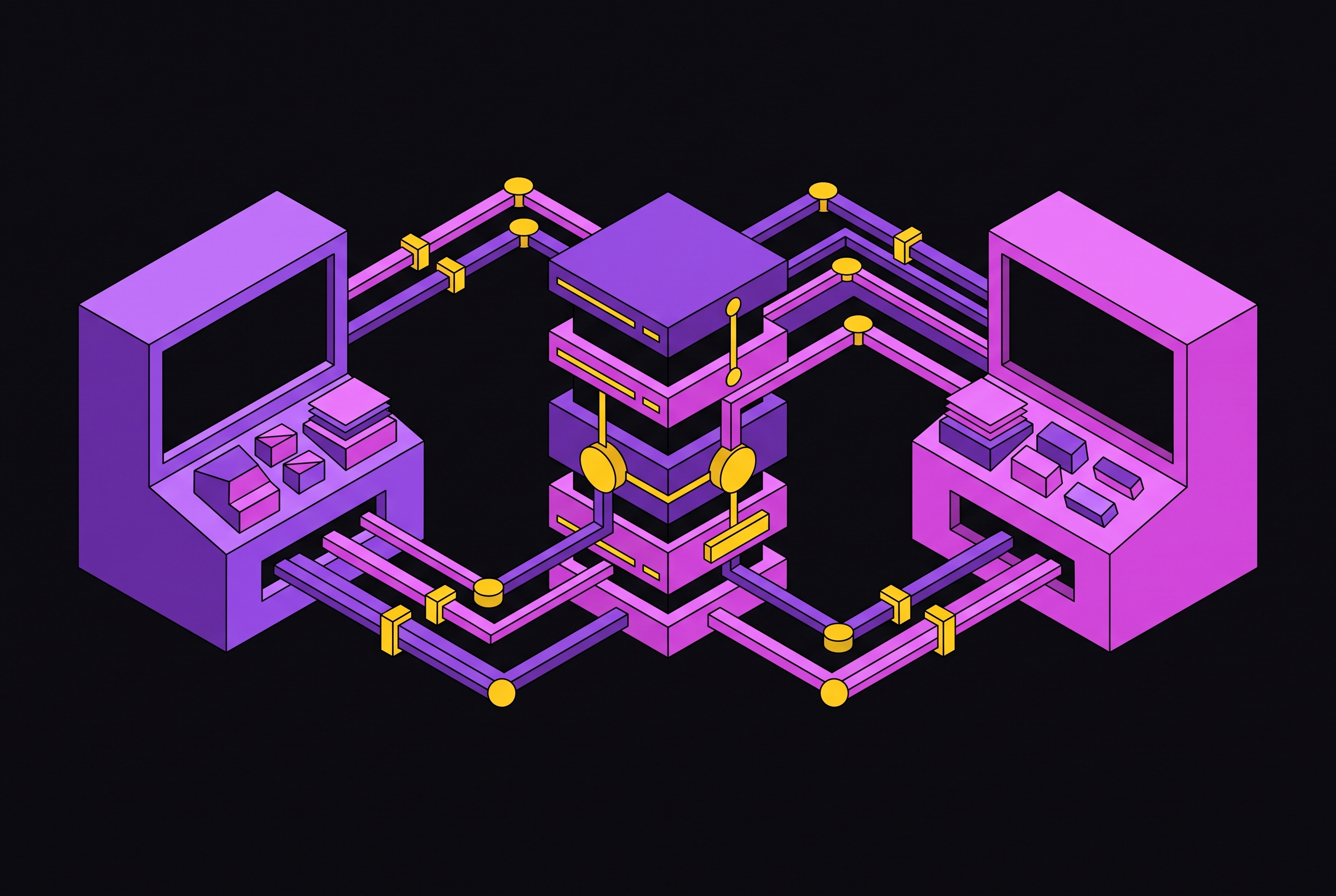
Claude Code is a command-line tool that sits in the terminal, reads the codebase directly off disk, and works alongside the developer as changes happen. Codex takes tasks, runs them asynchronously in an isolated sandbox, and hands back a pull request or a diff once it's done. Both launched or relaunched as full agentic tools in 2025, and by 2026 they represent the two dominant paradigms in AI-assisted development Ironplate AI - Claude Code vs Codex Security Comparison.
Stack Overflow's Developer Survey put daily AI assistant use among professional developers at 68%, and found that Claude Code and Codex together account for 73% of reported AI tool usage among respondents Morph LLM - Codex vs Claude Code Comparison Orthoplex Solutions - Claude Code vs Codex 2026. Most backend teams face a different question: not whether to adopt an agentic coding tool. It's already been decided. It's which of these two to build a workflow around Ironplate AI - Claude Code vs Codex Security Comparison.
That question doesn't have a universal answer, and pretending otherwise misses the point. The right frame isn't "which tool is smarter", it's which execution model, interactive and local versus autonomous and cloud-based, matches how a given team actually builds and ships APIs. The sections that follow work through architecture, context handling, execution environment, and benchmark performance, each mapped against the specific demands of backend API development, where a bad decision doesn't just look wrong, it breaks things downstream.
What each tool is underneath the branding
Once installed, it runs from any project directory, with no cloud environment to configure. It reads the whole project, works out how the files relate to each other, and then plans, writes, and tests changes across multiple files in one pass. Under the hood it uses Claude's model lineup, with Claude Opus 5.5 the current default as of late September 2026, following Sonnet 5's run as the everyday default since v2.1.197 on June 30, 2026. Adoption numbers back up the traction: 101,000 GitHub stars and 15,500 forks, putting it among the most widely used AI coding tools of 2026 Medium - Claude Code 2026 Guide. The scale of actual output is harder to ignore: Claude is credited with authoring more than 326,000 GitHub commits a day, roughly 10% of all public commits Morph LLM - Codex vs Claude Code Comparison.
Codex carries a name with history attached, so the two products need to be separated cleanly Ironplate AI - Claude Code vs Codex Security Comparison. It integrates with GitHub, Slack, and Linear. OpenAI folded the standalone Codex app into the ChatGPT desktop app on July 9, 2026.
Strip away the branding, and one distinction actually matters for backend work: Claude Code is built for fast, developer-in-the-loop feedback, while Codex is built for sustained, unattended autonomy. Everything that follows, context handling, sandboxing, benchmark profile, traces back to that split. Claude Code is the tool in question. The current product is the 2025 full coding agent, distinct from the 2021 GPT-3-based autocomplete model that was deprecated in March 2023 (Ironplate AI - Claude Code vs Codex Security Comparison). It operates across four surfaces: a cloud web agent at chatgpt.com/codex, an open-source CLI in Rust, IDE extensions for VS Code, Cursor, Windsurf, and JetBrains IDEs, and a macOS desktop app launched February 2026 (per DataCamp). It grew to more than 2 million weekly active users by March 2026, and a later figure from the April 2026 guide puts it at 4M developers weekly (Wikipedia - OpenAI Codex (AI agent), Tosea - OpenAI Codex Complete Guide 2026).
Context window size on real backend codebases
Both tools launched or relaunched as full agentic tools in 2025, and by 2026 they represent the two dominant paradigms in AI-assisted development Ironplate AI - Claude Code vs Codex Security Comparison. Claude Code's default model runs natively at 1M tokens with no extra cost for using the full window Blake Crosley - Codex vs Claude Code 2026. Codex, by contrast, caps GPT-5.6 at 272K tokens in the CLI by default, with 872K available only if a developer manually sets model_context_window; Zapier has described the out-of-the-box window as modest next to Claude's Blake Crosley - Codex vs Claude Code 2026.
For backend API work specifically, this isn't an abstract spec difference. A typical backend service spans route handlers, middleware, database models, auth logic, validation schemas, and integration clients, files that reference each other constantly and don't sit next to one another in the repo. Claude Code's larger default window lets it hold more of that graph in view at once, which makes it more dependable on exploratory tasks where the scope of the problem shifts once work is already underway. Codex's smaller default window forces its harness to compact and reset context more frequently, which cuts the other way: it pushes toward tightly scoped tasks, because the agent has less room to wander before losing track of where it started.
A February 2026 Figma-to-code benchmark makes the tradeoff concrete Zapier - Codex vs Claude Code. Depth costs tokens. Efficiency costs thoroughness. Neither is wrong. They're just optimized for different jobs.
At the far end of scale, Rakuten reported 99.9% numerical accuracy running Claude Code against a 12.5-million-line codebase, which is the clearest data point available on how either tool holds up against genuinely enormous, sprawling repositories Morph LLM - Codex vs Claude Code Comparison. If the repo is messy and cross-referenced in ways nobody's fully mapped, Claude Code's larger in-tool window earns its keep. If the API work is already broken into discrete, well-scoped tickets, that advantage matters far less. Both tools now reach 1M tokens, and the gap that existed in early 2026 has closed at the model level (per morphllm.com) (Blake Crosley - Codex vs Claude Code 2026). This is what context window size means for backend API work.
API design quality: where each tool's reasoning style produces different output
Designing a backend API means getting several things right at once: resource naming, HTTP method semantics, pagination strategy, error response shape, versioning, security posture. A cosmetic bug in a frontend component is annoying but recoverable. A structural flaw baked into an API contract tends to outlive the sprint that introduced it, because clients build against it and every fix becomes a breaking change.
Claude Code's output in this domain tends to show its reasoning. It weighs resource naming conventions, HTTP method semantics, pagination strategy, and error format together rather than treating them as separate decisions, and its designs line up with established references like the JSON:API specification and Google's API design guidelines, with the rationale for each choice usually spelled out alongside the code. Given an imperfect prompt, it tends to read between the lines and proceed on its best interpretation rather than stopping to ask.
Codex's designs work, and work correctly, but the reasoning style behind them is different in a way that appears under ambiguity. It's a literal tool: it follows the instruction it was given precisely, and an imprecise instruction is more likely to produce a result that's technically correct but not what was meant. That same literalness cuts the other way when the spec is solid, since it makes Codex reliably good at catching subtle bugs and untangling hard backend logic, and it tends to investigate and push back on unclear prompts rather than guessing. Language alignment follows a similar pattern: Claude Code's strengths lean toward frontend or full-stack work.
The numbers on perceived quality versus daily preference pull in opposite directions, and that split deserves attention rather than smoothing over. Blind code reviews rated Claude Code's output cleaner 67% of the time, yet a Reddit survey of more than 500 developers found 65% preferring Codex for daily use Ironplate AI - Claude Code vs Codex Security Comparison. Read together, that split suggests Codex wins on feel and habit, the day-to-day experience of using it, while Claude Code wins on the output sitting in front of a reviewer. For backend teams, greenfield API contracts and refactors where strict adherence to a specification matters lean toward Claude Code's design judgment, while tightly scoped tickets against a contract that already exists play to Codex's literal-mindedness. This is Claude Code's approach to API design. This is Codex's approach to API design.
Sandboxing and local execution for teams with complex dev environments
Codex's cloud sandbox runs in two phases Ironplate AI - Claude Code vs Codex Security Comparison. First comes setup, with network access on so dependencies can install, and then the agent phase, where network access is disabled by default. Safety enforcement happens mostly at the OS kernel layer, through Seatbelt, Landlock, and seccomp, tied to a twelve-event hook system that's been stable since CLI v0.145.0. The network isolation during the agent phase is deliberate: it stops generated code from reaching out to external services or pulling in unintended packages while it's running unsupervised.
That design has a real consequence for backend work specifically. A backend API rarely exists in isolation, it talks to a live Postgres instance, a Redis cache, a message broker, and none of those are reachable once Codex's agent phase cuts network access. Teams have to supply configuration so the agent can approximate that environment rather than actually reaching it.
Claude Code sidesteps the problem by not needing to approximate anything. It runs inside the developer's real environment, so Docker Compose setups, local databases, and real service mocks are all just there, reachable the same way they'd be reachable for a human typing commands. For teams whose local setup is already complicated, that's a genuine practical edge: there's no environment-parity gap to manage, because there's only one environment. Backing that up is a hook system that's grown to 31 programmable lifecycle events as of August 2026, up from 25-plus in May: PreToolUse hooks block dangerous commands before they run, PostToolUse hooks run linters and security checks after every action, Stop hooks validate the final output, and all of it executes deterministically, without routing back through the model Ironplate AI - Claude Code vs Codex Security Comparison Blake Crosley - Codex vs Claude Code 2026. Bash execution itself runs OS-level sandboxed through Seatbelt or bubblewrap, and since v2.1.219 a strictAllowlist setting refuses connections to any host not explicitly permitted.
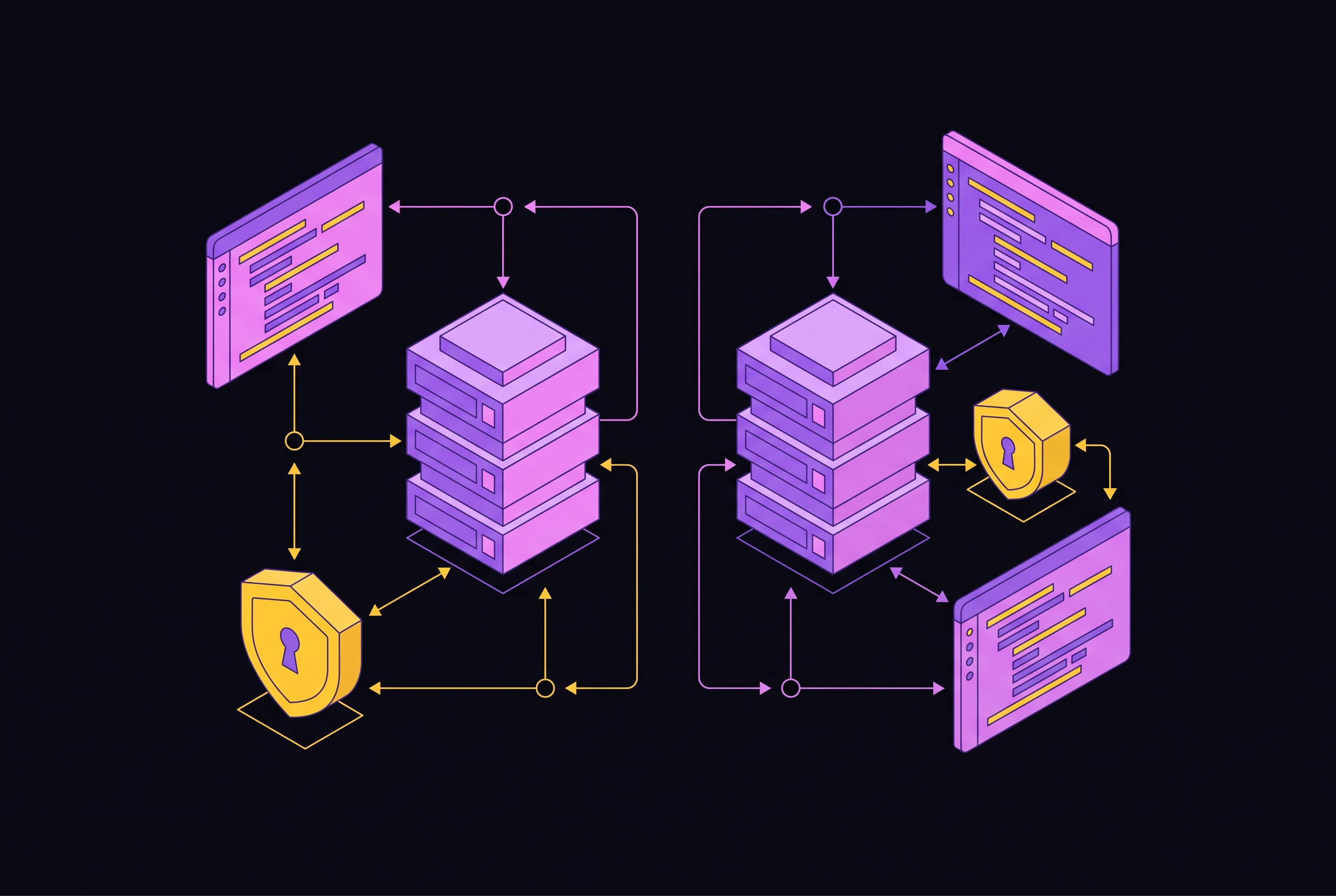
The practical split, then, comes down to how contained a team's environment already is. Teams running well-containerized setups, Docker Compose, reproducible builds, can work comfortably inside Codex's sandbox constraints. Teams with tangled local dependency graphs get more direct value from Claude Code's ability to just reach into the environment as it exists. This is Claude Code's local execution model. In the security posture comparison, Codex enforces a hard perimeter at the sandbox boundary, while Claude Code enforces policy through deterministic hooks, and a hook that blocks a dangerous command will block it every time, unlike a prompt instruction the model might override (ironplate.ai).
Benchmark performance on the tasks backend API work resembles
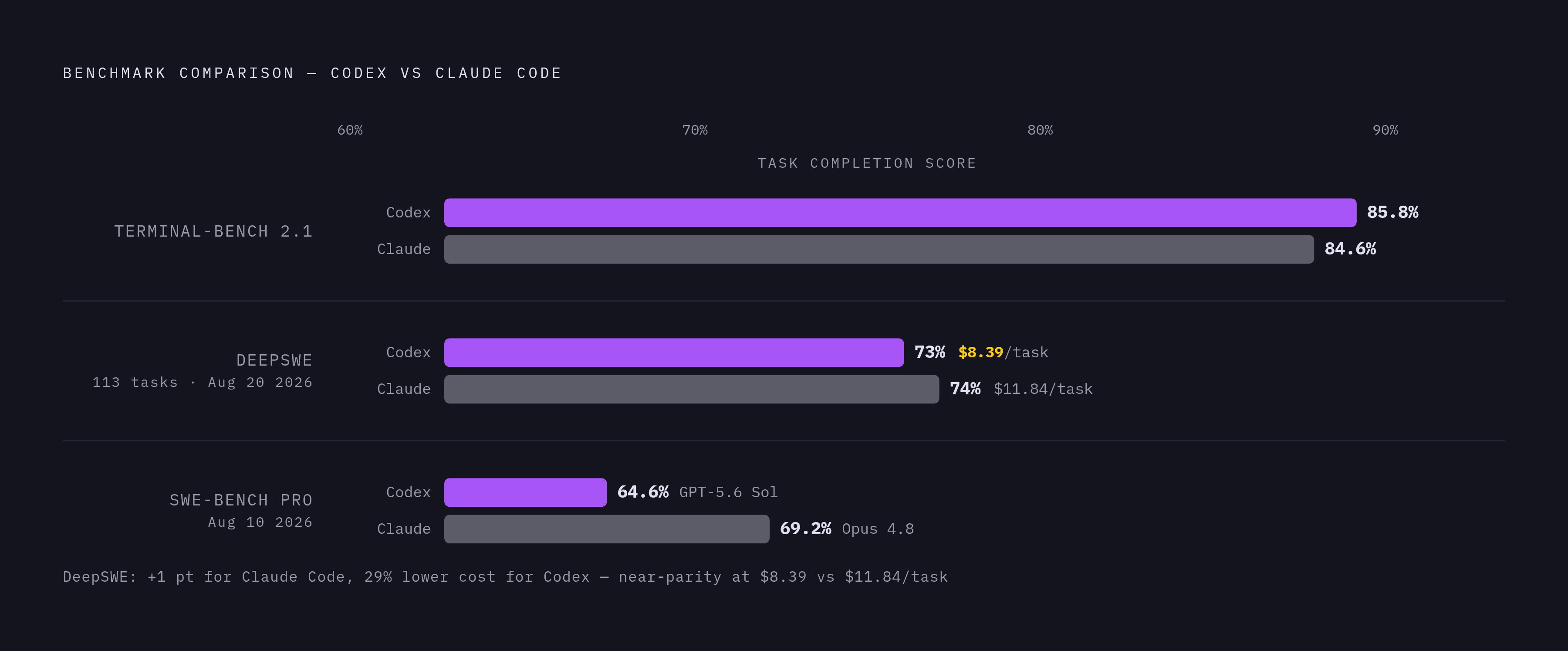
Codex running GPT-5.6 Sol leads Terminal-Bench 2.1 at 85.8%, against Claude Code's 84.6% on the same independent run Morph LLM - Codex vs Claude Code Comparison. On DeepSWE, a 113-task benchmark run August 20, 2026 on a shared harness, Claude Opus 5 resolved 74% of tasks at $11.84 each, while GPT-5.6 Sol resolved 73% at $8.39 each Morph LLM - Codex vs Claude Code Comparison Orthoplex Solutions - Claude Code vs Codex 2026. On SWE-bench Pro, a vendor aggregate from llm-stats dated August 10, 2026, Opus 4.8 scored 69.2% against GPT-5.6 Sol's 64.6%, though Opus 5 hadn't been listed on that board yet Morph LLM - Codex vs Claude Code Comparison.
These numbers deserve some skepticism before anyone leans on them too hard. OpenAI itself said that SWE-bench Verified is becoming less reliable because of contamination concerns, which should temper how much weight the 97.0% figure carries Morph LLM - Codex vs Claude Code Comparison. Vendor-run scaffolds also tend to score noticeably higher than Scale's standardized harness on SWE-bench Pro. The absolute percentages matter less than where each tool lands relative to the other. Terminal-Bench 2.1 is probably the benchmark closest to what backend terminal work actually looks like, and Codex's edge there, 85.8% versus 84.6%, is narrow but consistent with a tool built around terminal-first, autonomous execution Morph LLM - Codex vs Claude Code Comparison.
Put the numbers side by side. The pattern that emerges is closer than the headline scores suggest. DeepSWE's near-parity, 74% against 73%, means neither tool holds a commanding lead on a standardized task set, so the fit between tool and workflow ends up mattering more than the score gap Morph LLM - Codex vs Claude Code Comparison Orthoplex Solutions - Claude Code vs Codex 2026. Cost tells a clearer story: Codex resolves a DeepSWE task for roughly 29% less than Claude Code does, $8.39 against $11.84, which adds up fast for a team running high volumes of small, discrete API tickets Morph LLM - Codex vs Claude Code Comparison. Claude Code's edge on SWE-bench, meanwhile, tracks with work that rewards depth over speed: large refactors, schema changes that ripple across several layers, API versioning migrations, and open-ended work where thoroughness pays for itself. This is the overall picture as of September 2026 (morphllm.com, re-verified September 21, 2026). Claude Code (Opus 5) scores 97.0% on SWE-bench Verified on the independent vals.ai leaderboard, ranking #1 on that board (Morph LLM - Codex vs Claude Code Comparison). This is what the benchmark pattern implies for backend API teams.
Parallel task execution and multi-agent workflows for backend API development
Backend API features rarely arrive as one task. They break down into route handlers, database migrations, input validation, auth middleware, integration tests, and documentation, workstreams that can run in parallel if whatever's coordinating them can actually keep track of how they depend on each other.
Codex handles this by spawning up to eight parallel subagents, each running in its own isolated cloud sandbox, a capability that reached general availability in September 2026. Each sandbox operates independently, which suits work that doesn't need shared state or agents talking to each other mid-task. Combined with its GitHub, Slack, and Linear integrations, the whole setup fits a delegation-and-review workflow where a team lead submits tasks and reviews PRs.
Claude Code takes a different route: multiple Claude Code instances work simultaneously, coordinated by a lead agent that assigns subtasks, tracks dependencies, and merges results back together. The instances share a task list and pass messages to each other, which matters when subtasks aren't independent, when one piece of work can't finish until another one does.
A broader pattern shows up here too. Claude Code tends to win consistently on frontend and UI work, while Codex tends to win on long-running, autonomous backend tasks, largely because its cloud agent can run unattended for hours and its approach to compacting context holds up over that stretch. This is the Claude Code Agent Teams model. It is better suited when API layers are tightly coupled, for example, a schema change in the database model must be reflected in the validation layer and the route handler before any can be finalized. The practical read is that Codex's 8-sandbox parallelism is the right tool when backend tasks can be cleanly decomposed into independent work items, while Claude Code's Agent Teams with messaging and dependency tracking are the right tool for tightly coupled work.
Sources
- Codex vs Claude Code (September 2026): Benchmarks, Subagents & Limits Compared
Provided benchmark figures including Terminal-Bench 2.1 scores, DeepSWE task resolution rates and costs, SWE-bench Pro results, and the Rakuten 99.9% accuracy figure.
- OpenAI Codex (AI agent) - Wikipedia
Provided the figure of 2 million weekly active users for Codex by March 2026.
- https://zapier.com/blog/codex-vs-claude-code/
Referenced for the February 2026 Figma-to-code benchmark illustrating the context window tradeoff between depth and efficiency.