AI Coding Tool Latency and Its Effect on Developer Flow State
Research shows AI coding tools slow experienced developers down despite feeling faster.
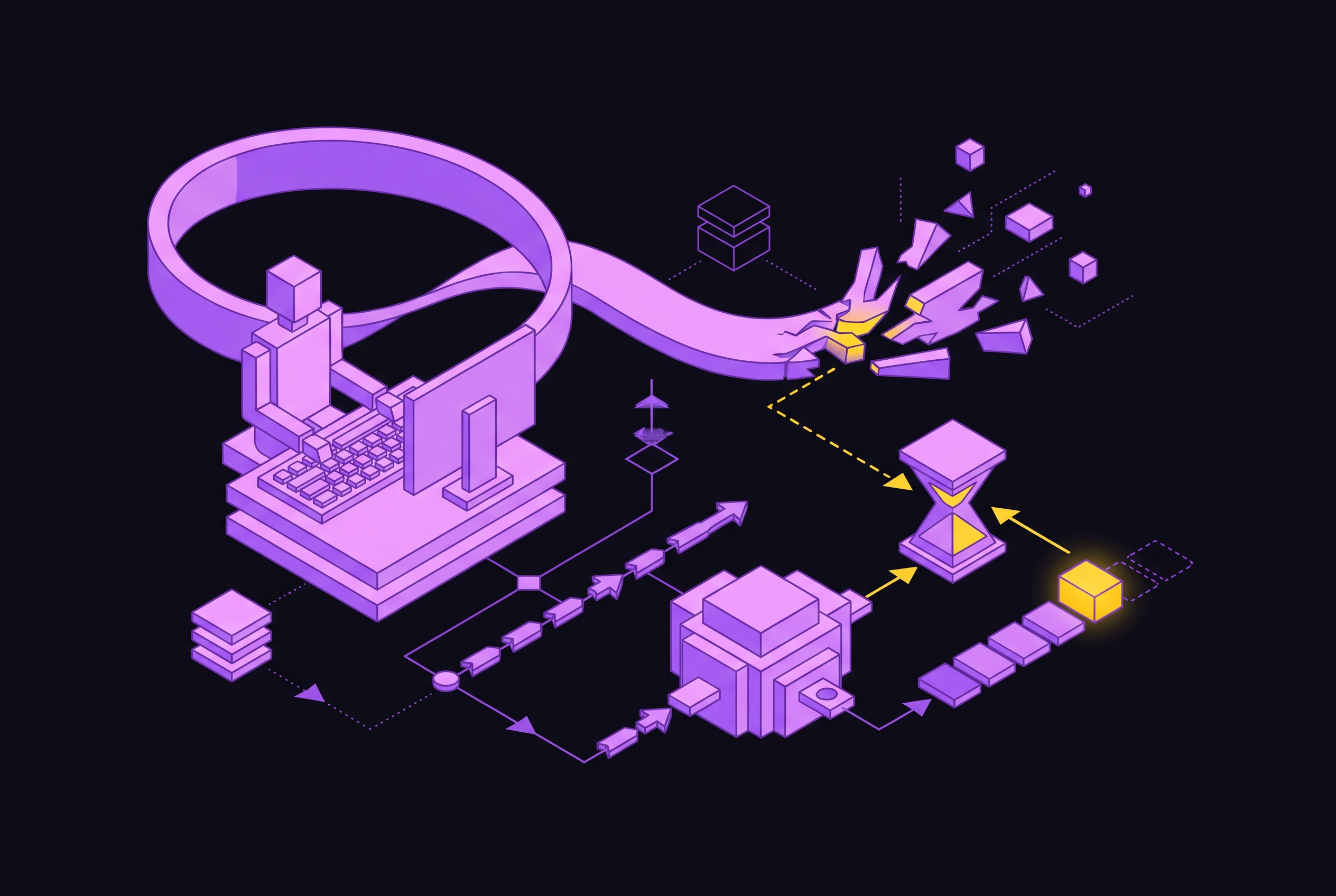
Flow state, as one influential psychologist described it decades ago, is a condition of total immersion where attention narrows and performance climbs. For a developer, that immersion has a specific shape: holding a mental model of the codebase, its dependencies, and its likely failure points all at once, in working memory, without writing most of it down. That model lives nowhere durable. It sits in the developer's head, updated line by line, and it falls apart the moment attention gets pulled somewhere else.
Flow, for programmers, is not a nice mood to be in. It functions closer to a load-bearing wall. More than half of developers say their most productive days are the ones with the fewest interruptions and the least context switching, and once that mental scaffolding breaks, rebuilding it costs real time. Research on task interruption puts the average recovery period at just over 23 minutes to fully resume the original task. An interruption rate of just 10% can nearly double total task time, because each break does not just cost its own duration. It compounds against every other disruption already sitting in the queue.
That is the baseline condition AI coding tools are stepping into. Any tool that adds friction to the loop, even friction measured in seconds, intrudes on a structure that was already brittle before AI showed up.
The rise of AI coding tools as a constant presence in the development loop
Adoption happened fast, and it happened almost completely. Stack Overflow's 2025 developer survey found that 92.6% of developers use an AI coding assistant at least monthly, and 51% of professional developers use one daily. Writing code without one of these tools open is becoming the exception across the profession. Writing code without one of these tools open is now the exception, not the norm.
The market numbers track the same story. GitHub Copilot alone reached 20 million cumulative users by mid-2025, gaining 5 million in just three months, and has been adopted by 90% of Fortune 100 companies. At that scale, whatever flow disruption is baked into these tools plays out across nearly the entire population of professional developers, simultaneously, every working day.
The interaction itself has changed shape beneath that adoption curve. Three tiers of AI coding tool coexist now, and they ask fundamentally different things of a developer's attention. Autocomplete, the first tier, predicts the next line or block as someone types; the developer never leaves the stream of typing, and the tool rides alongside the motion that is already happening. The second tier, the AI assistant, needs a deliberate invocation. Developers open a chat pane, ask for an explanation or a refactor, and wait for a considered answer before returning to the file. The third tier, the autonomous agent, works differently again: the developer hands off a goal across files, tests, and iterations, then steps back entirely while the agent runs.
Each tier interrupts in its own way, because each asks for a different kind of attention. That difference in interruption pattern is what determines how much latency a developer can tolerate before the wait itself becomes the problem.
AI Tools and Experienced Developers: Research Findings
METR ran a randomized controlled trial, published in 2025, that cuts through a lot of the industry's self-reported optimism about AI coding tools. The study used 16 experienced developers, not students or hobbyists, pulled from large open-source repositories averaging over 22,000 stars and more than a million lines of code. These were people with deep, demonstrated experience in large, complex codebases.
Across 246 real tasks, bug fixes, feature work, refactors, each was randomly assigned to either an AI-allowed or AI-disallowed condition. The AI-allowed group worked mostly with Cursor Pro running Claude 3.5 and 3.7 Sonnet, representative of the best tooling available at the time.
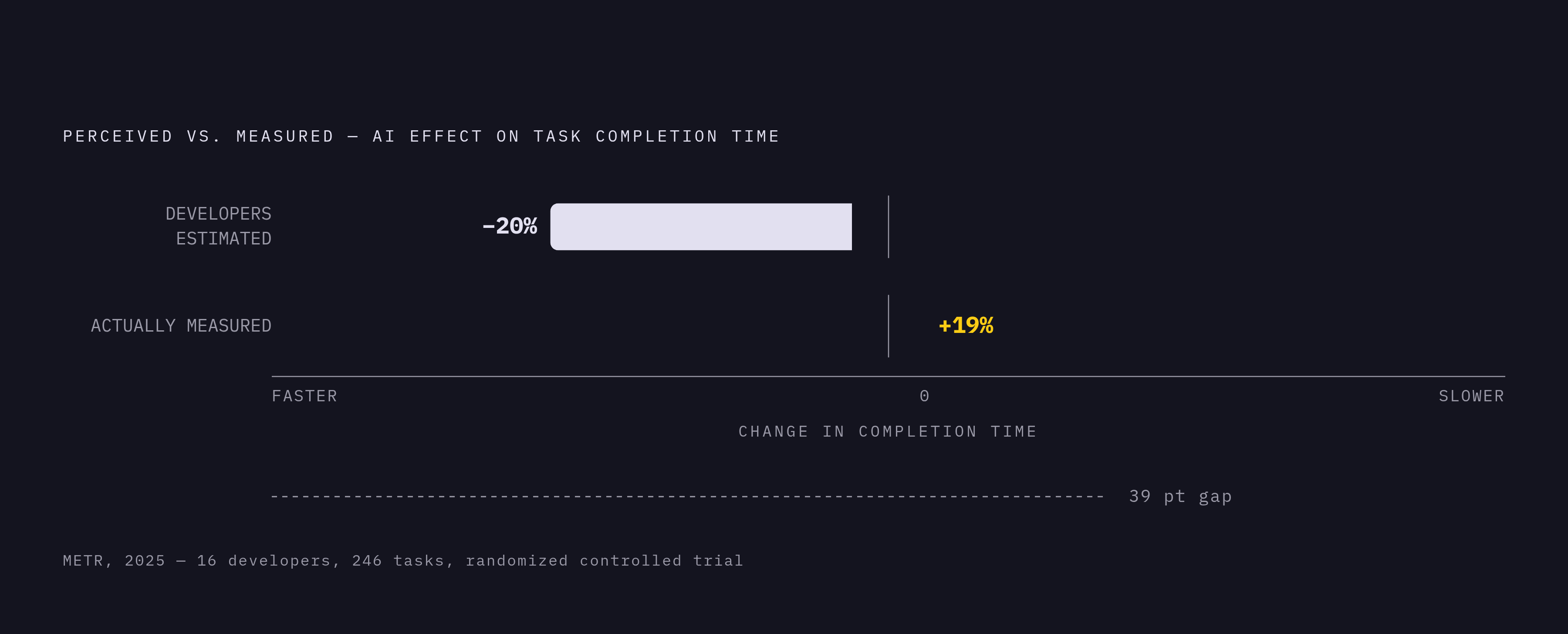
The result should worry anyone selling AI coding tools on productivity alone. Developers estimated that AI had cut their completion time by 20%. Measured against the clock, AI actually increased completion time by 19%. That gap between felt speed and actual speed is the single most important number in this body of research, because it means the developers in the study could not accurately sense their own slowdown while it was happening. Ars Technica's later analysis of the METR screen recordings found where a chunk of that time went: developers spent 9% of total task time specifically reviewing and modifying AI-generated code, an overhead category that simply did not exist before AI entered the workflow.
Latency's fracturing of the mental model, not just the schedule
Waiting on an AI response forces a context switch, and that is the mechanism the productivity numbers alone do not capture. During the 5 to 10 seconds a developer might spend waiting on a suggestion, the mental model they were holding, the dependencies, the edge cases, the half-finished plan for the next three functions, starts to decay. The developer is left with no good option: hold that fragile structure in place at real cognitive cost, or let it go and pay the full 23-minute recovery tax later.
METR's researchers named this directly, describing "extra cognitive load and context-switching" as a primary mechanism behind the productivity loss they measured. Developers using AI tools shifted repeatedly between coding and prompting across a session, and each shift added to a cumulative toll instead of resetting to zero.
The EditFlow research adds a sharper number: 68.81% of AI code edit recommendations disrupt a developer's mental flow, even when the suggestion is technically correct. Being right is not the same as being timely. More than two out of three suggestions land at the wrong moment, or in a form that does not match what the developer was actually thinking about at that point in the task.
None of this is abstract once it gets multiplied out. Waits of 5 to 10 seconds, repeated across hundreds of interactions in a single working day, produce the same non-linear, compounding cost that the interruption research already established. Latency in an AI coding tool does not behave like a performance metric. It behaves like an interruption, and it inherits all of an interruption's math.
The latency thresholds that matter, by interaction mode
General research on AI interface perception gives a rough map. Time to first token (TTFT) under 300 milliseconds registers as instant. Between 300 and 800 milliseconds, the delay is noticeable but tolerable. Once the delay crosses 800 milliseconds to 2 seconds, users start perceiving the system as slow, and past 2 seconds, drop-off rates climb 15 to 25%.
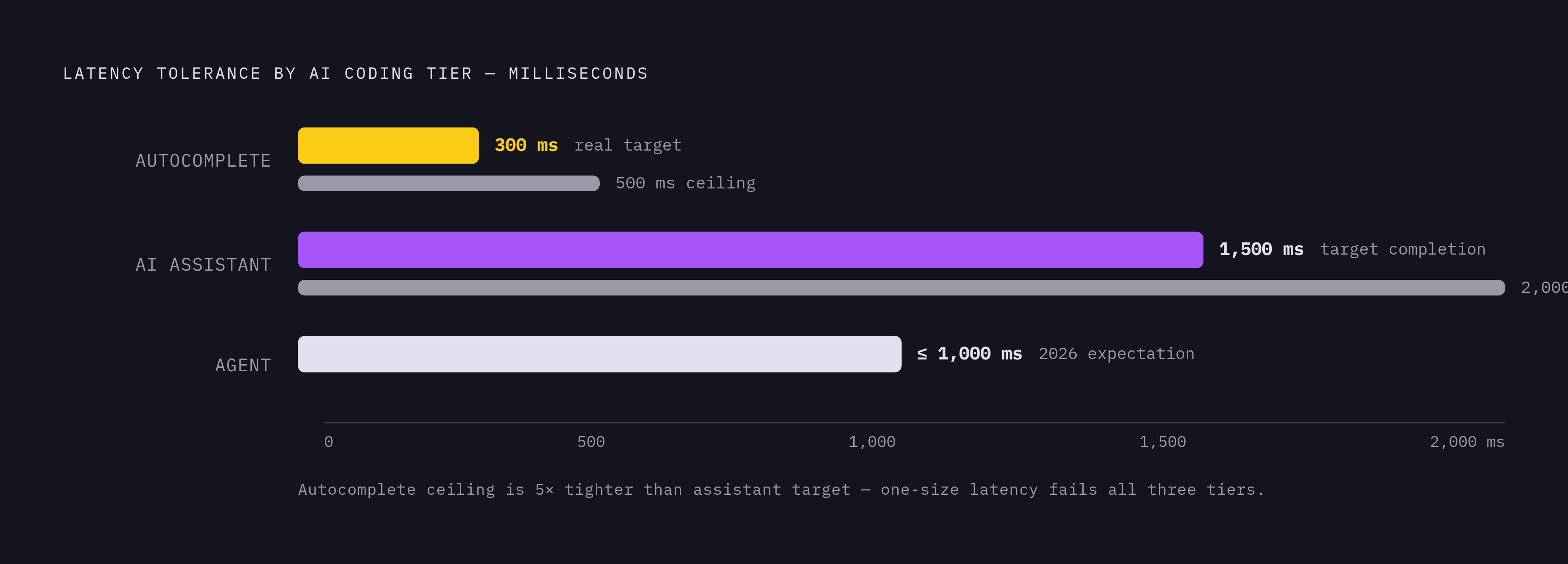
Those are general chat interface numbers, and coding tools do not get nearly that much slack. Tolerance shifts hard by tier. Autocomplete has to stay under 500 milliseconds TTFT to feel natural at all, with 300 milliseconds the real target: even 100 extra milliseconds of lag is enough to break typing rhythm, since autocomplete lives inside the act of typing, not beside it.
AI assistants get more room. Completion under 1.5 seconds is the target, and a TTFT of 1 to 2 seconds is tolerable, since the developer has already accepted that writing the code by hand would take longer anyway. The wait is priced into the decision to ask.
Autonomous agents get the most slack of all, since the developer has explicitly delegated the task and stepped out of the loop. That patience is not infinite, though. String enough agent steps together, each with its own wait, and the same compounding cost shows back up, visible again in the total time a developer spends idle.
The bar has moved over time, too. Three seconds of end-to-end response felt workable in 2024. By 2026 that number reads as a dealbreaker, with sub-second responses the expectation. That tension between speed and capability only sharpens as tools climb the tier ladder from autocomplete toward full autonomy.
Where current tools land on the latency spectrum
The spread across vendors in 2026 is wide, roughly a five-fold range from fastest to slowest. Groq's inference runs around 120 milliseconds; Google Gemini's median TTFT sits closer to 600 milliseconds. That gap is roughly the same order of magnitude as the one between "instant" and "noticeable" in the perception research above, and it means two developers running different tools are having qualitatively different experiences of the same workflow.
Individual tools land at different points on that spectrum for different reasons. GitHub Copilot typically returns suggestions quickly enough to sit firmly in the instant zone for autocomplete work. Cursor built its autocomplete speed through the Supermaven acquisition, folding that technology directly into Cursor Tab, and pairs it with repo-wide semantic search and a Plan Mode for scoping out implementation before code gets written. Cursor Pro runs about $20 a month.
Tabnine takes a different route, emphasizing privacy and a deployment model that reduces dependence on external network round-trips, at some cost to suggestion quality against cloud-hosted models. Augment Code claims faster inference through custom GPU kernels and real-time indexing across large codebases, and claims up to a 40% cut in hallucinations through what it calls comprehensive context engineering. That is an approach aimed at raw speed and at the verification overhead that slows developers down after the suggestion lands.
Zed comes at the problem from the editor level rather than the model level: a Rust-native editor built around GPU-accelerated rendering for low-latency editing from the ground up, with real-time collaboration built in and both free and paid tiers. Windsurf positions itself as the value alternative to Cursor at a lower monthly price point, and added five parallel agents in December 2025 with its Wave 13 update.
Speed alone does not settle the matter; treating it as the deciding factor is a mistake. A faster tool that is less accurate just trades one flow disruption for another: time spent verifying and correcting suggestions that arrived quickly but wrong. Augment Code's architecture targets that second disruption vector alongside raw inference speed, a tacit admission that latency and reliability are two separate problems, not one. Separately, Greptile's report notes that CLAUDE.md files, a form of context scaffolding, now appear in 80% of organizations, a sign teams are trying to cut per-query latency by feeding tools better context upfront rather than waiting on faster inference to solve the problem alone.
Faster inference alone does not guarantee flow is restored
The EditFlow paper's central argument cuts against the industry's instinct to treat latency as the whole problem, and it is the most important claim in this entire body of research. Speed of arrival matters, but fit matters just as much: whether a suggestion lines up with the specific reasoning step a developer is on right now. That 68.81% disruption rate is a timing and form problem, one that persists even when the underlying suggestion is technically correct, because most systems get built to produce a correct end result rather than to match the incremental, context-sensitive way developers actually think through a problem.
EditFlow's own approach makes the trade-off concrete. By reconstructing developer edit sequences as Keep, Jump, Revert, and Break states, drawn from temporal edit data rather than static commit snapshots, the system improved reconstruction accuracy by 63.81%, cut flow violations by more than 75%, and lifted recommendation precision by 66.99%. A user study with 32 developers found task completion 25.11% faster under the new approach.
That gain came at a literal latency cost. The sequence-aware system added, on average, about 1.71 seconds and 6,580 tokens per interaction, more overhead than a naive system, not less. It was slower and it still won, because the suggestion showed up in the right place and the right shape, which is worth more to a developer's flow than a faster wrong answer.
Cipan's essay, "Can Faster AI Inference Give Developers Their Flow Back?," circulating in developer productivity research circles as a key reference on tool failure modes, takes direct aim at the assumption that shaving milliseconds off inference time solves the problem by itself. The extra inference time is often worth paying, because it buys a more relevant next edit rather than a merely faster one. Latency and relevance are not the same lever, and treating them as interchangeable is how a fast tool ends up feeling just as disruptive as a slow one.
Steps developers and teams can take to protect flow given these constraints
Match the tool tier to the task on purpose, rather than defaulting to whatever happens to be installed. Autocomplete belongs in the in-flow moments, line completions and small blocks, and should be held to a strict sub-300 millisecond standard given how closely it rides alongside typing. AI assistants fit bounded, deliberate tasks, where a 1 to 2 second wait is a fair trade against writing the thing by hand. Agents make sense only for genuinely delegated work, the kind where stepping out of flow is a conscious choice rather than an unplanned tax.
Screen recordings identified four distinct overhead categories in work assisted by one model, visible in prompting time, wait time, review time, and time spent debugging its errors. That breakdown shows where time actually goes rather than where it feels like it goes. The 9% of total task time spent on review alone is a real, measurable drag, and it is one that better tool configuration and cleaner context can shrink directly.
Context quality works as a latency multiplier in its own right. Teams building out scaffolding like CLAUDE.md files, now present in 80% of organizations per Greptile's report, are effectively front-loading the information a model needs, which cuts down on the tokens and round-trips a query requires.
For developers on unreliable networks, or in environments where jitter is a constant headache, local models deserve real consideration for the autocomplete tier specifically. Tabnine's local option strips out the network round-trip entirely, trading some suggestion quality for a latency floor a cloud connection cannot guarantee.
None of this adds up to a universal fix, and pretending otherwise is exactly the mistake to avoid. These are tier-specific tools for a tier-specific problem. Treating latency as one undifferentiated number, rather than a variable that behaves differently at each tier, is what produced the 39-point gap between how fast developers think they are moving and how fast they actually are.
Sources
- Get the State of AI Coding Report | Greptile
Provided the statistic that CLAUDE.md files now appear in 80% of organizations, cited twice in the article.
- Why AI Coding Tools Make Experienced Developers 19% Slower and How to Fix It
Sourced the finding that developers spent 9% of total task time reviewing and modifying AI-generated code, drawn from Ars Technica's analysis of METR screen recordings.
- AI Tools for Developer Productivity in 2026: What Actually Works - Second Talent
Supplied the Stack Overflow 2025 survey figure that 92.6% of developers use an AI coding assistant at least monthly.
- Can faster AI inference give developers their flow back?
Provided the core argument that shaving milliseconds off inference time alone does not restore developer flow, cited as Cipan's essay in the article.
- https://metr.org/blog/2025-07-10-early-2025-ai-experienced-os-dev-study/
Provided details of the METR randomized controlled trial, including the 16 experienced developers, 246 tasks, and repositories averaging over 22,000 stars.