Skill Atrophy Risks for Junior Developers Using AI Assistance
Junior developers lose critical debugging skills they don't yet realize they need.
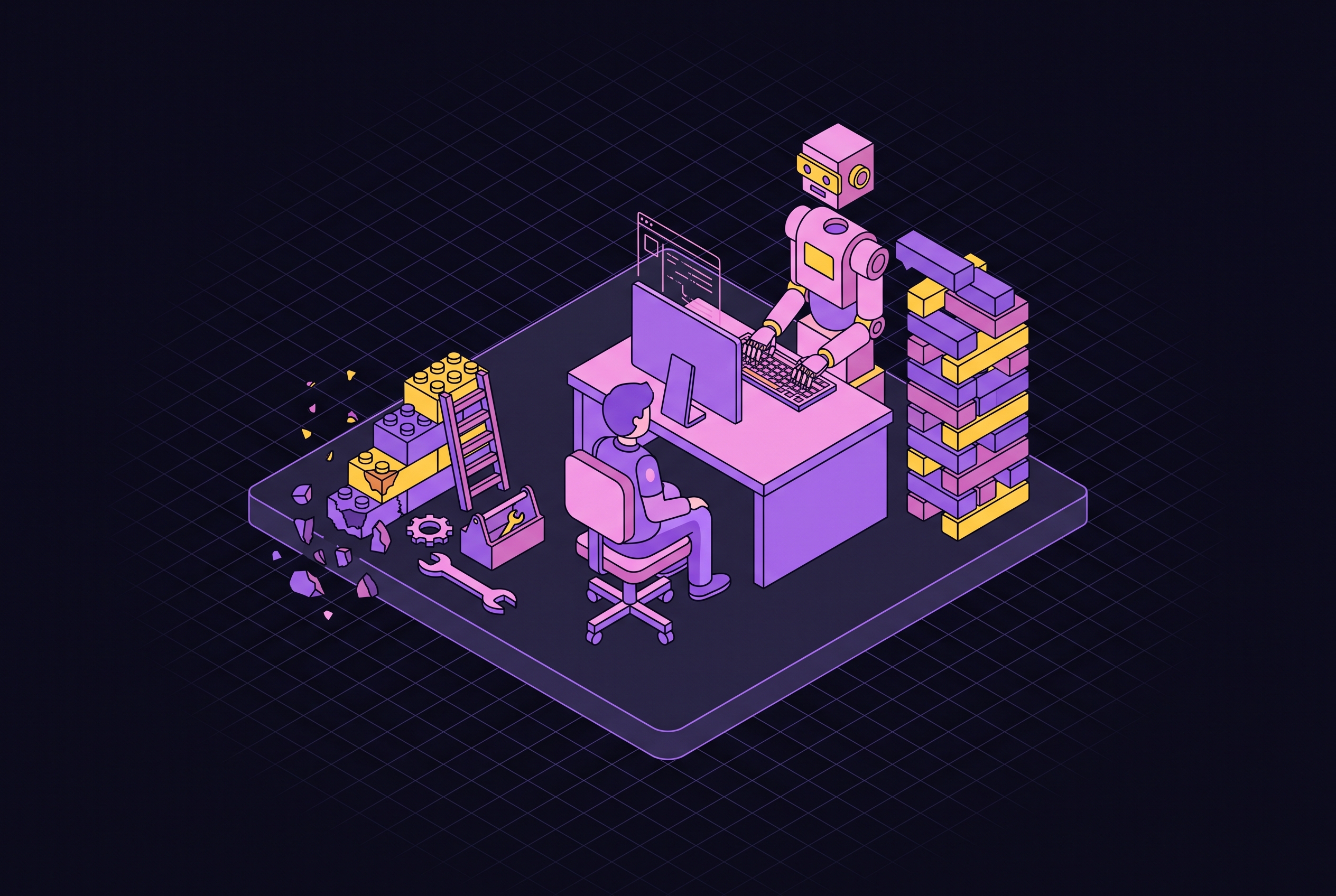
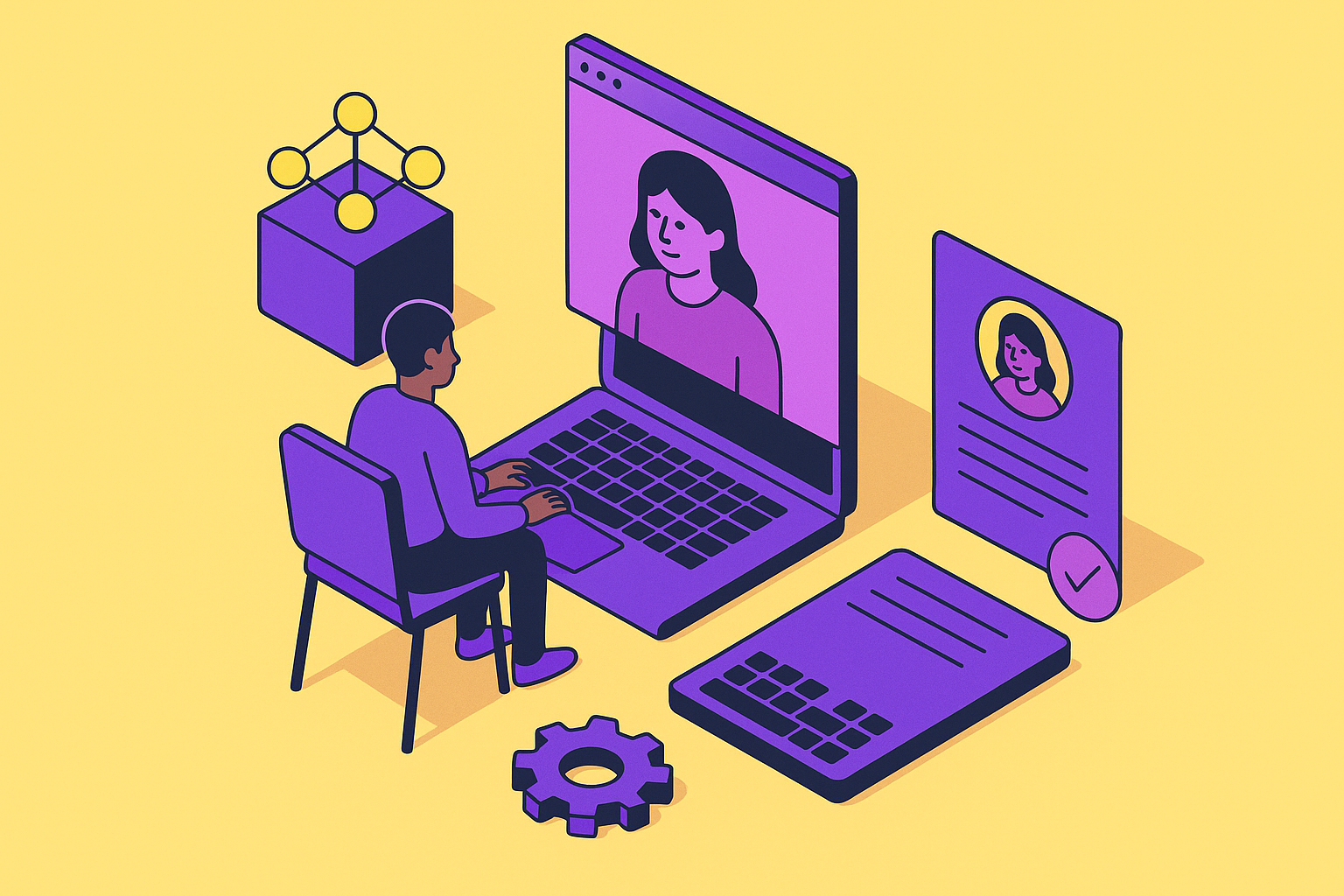
A junior developer opens a ticket on Monday morning, pastes the requirements into an AI coding assistant, and ships a working feature by lunch, work that would have taken the better part of a week two years ago. The ticket closes. The pull request merges. The dashboard records another win. None of that is an illusion: junior developers using AI coding tools genuinely ship faster, close tickets at a higher rate, and report feeling more confident earlier in their careers than developers did before these tools existed. A randomized trial with experienced developers even found that code written with AI assistance was more likely to pass unit tests, and it scored higher on readability, reliability, and maintainability, a real quality signal and not just a speed trick. Teams measure what they can see: pull request counts, story points, features shipped, and by every one of those measures, AI assistance looks like an unqualified win. The question this piece asks is what those dashboards cannot see: whether the person who shipped the feature actually understands it, could maintain it under pressure, or could reproduce the reasoning behind it without the tool open in another tab. That gap between visible output and built capability accumulates across months of tickets, not a single afternoon. It accumulates, quietly, across every ticket where the tool did the thinking and the developer did the typing.
How cognitive offloading works and erodes skill rather than redistributing it
Handing code generation to an AI assistant is not simply a more efficient way of getting the same work done. It substitutes for the effortful, often frustrating practice that builds skill that lasts. You learn to write a recursive function, trace a race condition, or design a schema under real constraints through repetition and struggle, not by watching a correct answer appear on screen. A tool that removes the struggle also removes the mechanism that forms the skill. Microsoft's research into AI-assisted work, built on surveys and behavioral data rather than brain imaging, documents real cognitive shifts during AI-assisted coding sessions: patterns in how developers allocate attention and effort change measurably when a model is doing part of the work, not just according to what developers report feeling afterward.
What shifts is the kind of mental work a developer does. Instead of holding a problem in working memory and recalling how to solve it, a developer assisted by AI spends more time integrating a suggestion into context and checking whether it looks right. For a senior engineer with a decade of hard-won mental models already in place, that shift is often a net gain. It frees attention for higher-order judgment. For a junior developer who has not yet built those mental models, the same shift is a loss, because the recall practice that would have built them never happens.
AI-generated code carries a danger that older productivity tools never had. A calculator is deterministic: the same input always produces the same, correct output, and a user who trusts it is rarely burned. AI-generated code is not deterministic in that way. It can compile, pass the available tests, and still fail the actual requirement in ways invisible to anyone who cannot reason about the code independently. A developer who accepted that output without engaging with it has nothing to stand on when it breaks in production, no mental model of why the code worked in the first place, and no fast way to find out why it stopped.
That is what makes the pattern self-reinforcing rather than a one-time trade-off. Every time a developer delegates instead of debugging by hand, the neural and procedural pathways tied to manual problem-solving get less use, which makes the next manual debugging session harder, which makes delegating the one after that more appealing. Shipping fast feels good in the moment the ticket closes, and that feeling rewards the exact behavior that is quietly costing the developer the skill they will need the next time the tool gets something wrong.
Research on Skill Loss Under AI Assistance
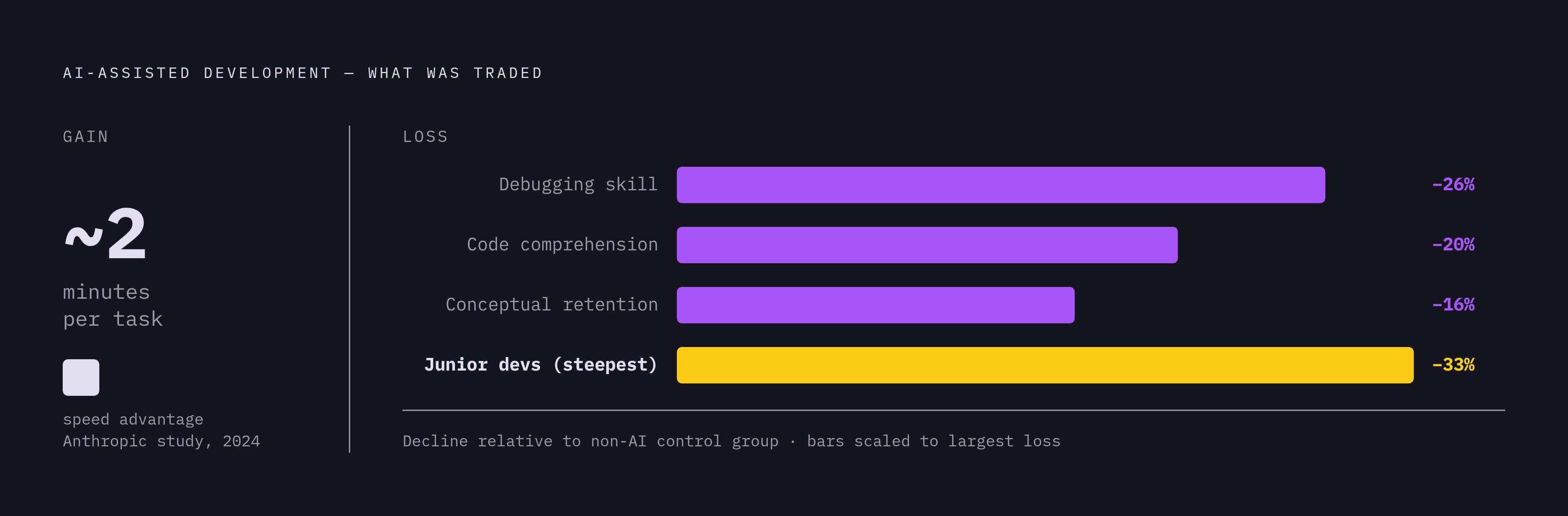
Controlled studies now back up what the mechanism predicts: AI-assisted developers finish tasks faster, but when the tool is taken away, they show meaningfully weaker understanding and retention of what they just built, and the effect lands hardest on the least experienced developers. An Anthropic study measured developers on debugging, code reading, and conceptual understanding, and it found the steepest decline in debugging, the specific skill of recognizing that code is wrong and figuring out why. That result matters because debugging is the skill that tells a developer when to stop trusting the tool.
The same study found the speed advantage from AI assistance was close to negligible, around two minutes. Developers who leaned on the tool traded away real comprehension for a productivity gain that was barely worth measuring. The effect was not uniform across participants, either. Those who used AI as a thinking partner, questioning its suggestions and reasoning through them, held onto their skills far better than those who fully delegated code generation and showed the steepest learning deficits in the study. The split tracked almost exactly with how developers used the tool: lower-scoring participants treated it as a code dispenser, accepting output and moving to the next ticket, while higher-performing participants stayed engaged with the reasoning behind each suggestion.
A separate study looked at AI-assisted work on legacy codebases and found a comparable split between performance and comprehension. Participants completed tasks faster and passed more test cases with AI assistance, but their understanding of the codebase itself did not grow at anything close to the same rate. That gap matters most for junior developers, because comprehension of a codebase, not just the ability to close an individual ticket, is what eventually lets someone maintain it, extend it, and debug it when something goes wrong at 2 a.m. Finishing a task faster in that context is not evidence of growing capability. It can just as easily be evidence that a capability gap is being covered over rather than closed.
The most dangerous part of this pattern is that developers cannot feel it happening. Skill atrophy builds up over weeks and months and does not go away with a weekend off, but ordinary cognitive fatigue does. If a developer loses debugging skill to disuse, they do not feel less capable from one day to the next. The tickets still close. The pull requests still merge. The feeling of productivity persists right up until a problem appears that the tool cannot solve and the skill needed to solve it manually is gone. Research out of Lund University looking specifically at how AI coding assistants shape a developer's mental model of the systems they work on flags this as a serious concern for how skill actually develops over a career, not just how quickly code ships in any given sprint.
Which specific skills erode first
Skill loss under AI assistance does not spread evenly across a developer's abilities. It concentrates exactly where AI assistance is most complete, and those happen to be the domains that senior engineering judgment depends on most. Junior and mid-level developers are showing measurable gaps in systems design, memory management, concurrency, and security architecture, the areas where AI output looks most plausible on the surface and requires the most contextual judgment to check properly.
Debugging intuition tends to go first, and it goes fastest. When AI generates working code on the first try, a developer never gets the repeated practice of breaking a failure down, reading an unfamiliar error message, and tracing behavior across service boundaries to find where things actually went wrong. Architectural understanding erodes close behind it. A developer trained to evaluate code one completion at a time, line by line, rarely builds a clear picture of how those individual pieces fit into the system they are supposed to serve.
The pattern appears in specific, recognizable ways on teams that lean hard on AI with junior staff. A developer can generate a full working microservice in minutes but struggle to explain why it should communicate synchronously or asynchronously with the rest of the system, or what eventual consistency would cost them down the line. A developer can let the tool suggest a data structure, but then not be able to manually optimize a hot path once it hits real production load. Prototypes come together quickly, but the systems behind them are often fragile and tightly coupled in ways that make scaling or refactoring painful later. And when the tool is unavailable, in a restricted environment, offline, or in a live interview, productivity often collapses in a way that makes the underlying gap impossible to miss.
Senior developers are not protected from this pattern by seniority itself. The same mechanism of cognitive offloading applies whenever an experienced engineer consistently hands off a specific domain, CSS, database migrations, build configuration, even while staying sharp everywhere else. What separates a senior engineer from a junior one here is not immunity but the depth of mental model built up before the delegation started, which buys time before the atrophy becomes consequential, a head start juniors begin without. Juniors start that clock with far less built up. That is why the same habit costs them more.
How organizational structure around junior developers amplifies individual risk
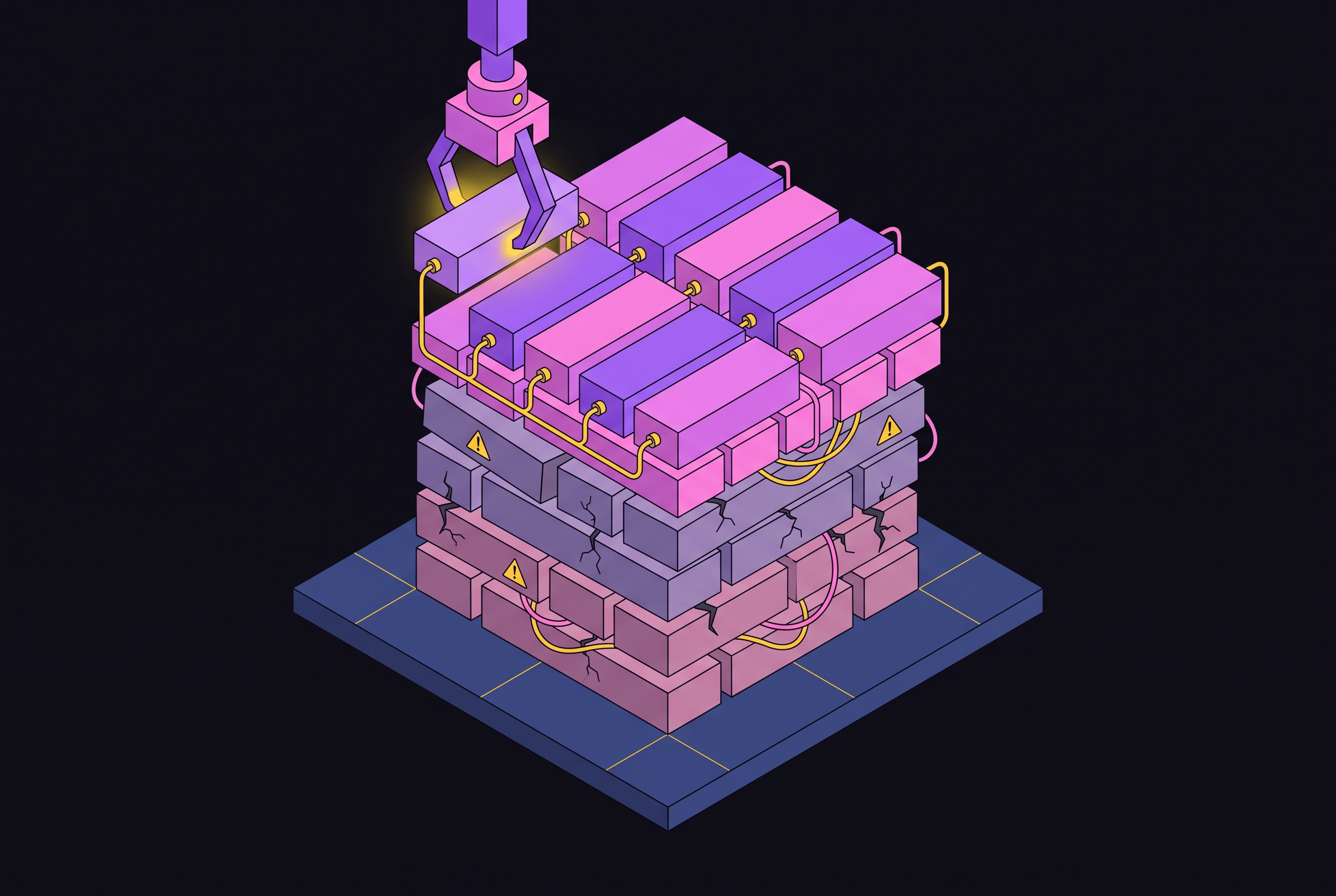
The risk described above is not just an individual habit problem. Most teams deploy AI tools around junior staff in a way that strips out the scaffolding that used to compensate for inexperience: close mentorship, deep code review, and steady exposure to production complexity. When AI absorbs the boilerplate work, junior developers lose the repetitive, low-stakes implementation tasks that used to be how they absorbed real architecture, coding standards, and the quirks of a team's build system. That grind looked inefficient from the outside, but it was doing real work.
Senior engineers shift role in the same process. Instead of mentoring, they spend more of their time reviewing a higher volume of AI-generated code, which occupies the attention that used to go toward transferring judgment and context to the people coming up behind them. Meanwhile the metrics most teams track, pull request counts and story points, reward exactly the behavior that produces this outcome, while longer-horizon signals like code maintainability, time to onboard a new hire, or the depth of incident resolution go largely unmeasured. The incentive structure rewards the pattern that causes the atrophy, not the one that prevents it.
AI tools deliver a large, genuine productivity boost to senior engineers and, at the same time, impose what some observers call "AI drag" on early-career developers who do not yet have the judgment to steer, verify, and integrate what the tool produces. The asymmetry is structural rather than a matter of effort or attitude. A senior developer using AI to speed up work they already understand deeply is genuinely more productive. A junior developer using AI to generate work they do not yet understand is substituting output for the learning that output was supposed to represent.
Traditional pair programming, two developers sharing one workstation, catches bugs earlier, moves knowledge in both directions, and tends to produce developers who actually understand what they ship. AI pair programming does not work the same way. It rarely pushes back on an idea, and while it can explain its own reasoning when asked, it does not challenge assumptions or argue for a different approach the way a human partner does. The economic logic that makes AI assistance attractive to a team, more output from one developer and fewer senior hours spent mentoring, is the same logic that strips out the conditions a junior developer actually needs in order to grow into a senior one.
The pipeline effect: how companies quietly stopped hiring juniors
Skill atrophy inside individual teams is compounding with a separate shift in the labor market: junior developer roles are disappearing faster than most candidates can develop the skills those roles used to teach. Engineers at a major tech company have described this as the "narrowing pyramid hypothesis. Junior developers have traditionally entered organizations through bug fixes and straightforward implementation work, low-stakes tasks that exposed them to real architecture, coding standards, and build systems, before a portion of them rose over years into tech lead roles. That entry point at the base of the pyramid is contracting. Fewer junior developers enter the pipeline, and because the effect lags by years, fewer senior engineers will emerge from it later, a shortage the industry has not yet fully felt.
The structural irony sits in front of the industry: the companies moving fastest to replace junior headcount with AI assistance are the same ones accelerating the conditions that will make experienced engineers scarce later. AI delivers a real productivity multiplier for senior engineers today, but senior engineers do not appear from nowhere. They are the product of a junior pipeline that is narrowing at the exact moment the industry is leaning hardest on the people that pipeline used to produce.
Sources
- The Impact of AI Coding Assistants on Software Engineering: A Longitudinal Study
Provided the randomized trial findings on AI-assisted code quality, including unit test pass rates and readability, reliability, and maintainability scores cited in the opening paragraph.
- How AI assistance impacts the formation of coding skills \ Anthropic
Provided the controlled study findings on debugging skill decline, the near-negligible two-minute speed advantage, and the split between developers who used AI as a thinking partner versus a code dispenser.
- Short-Term Gain, Long-Term Fragility: AI Labor Substitution and the Erosion of Sustainable Capability
Provided the framing of short-term productivity gains masking long-term capability erosion, underpinning the article's central argument about skill atrophy accumulating invisibly across tickets.
- How AI Impacts Skill Formation
Informed the discussion of how AI assistance changes the kind of mental work developers do and the mechanism by which skill formation is disrupted rather than merely redistributed.
- How AI Assistance Affects Human Skill Development: A Study of Learning with Logic Puzzles
Supported the finding that AI-assisted participants complete tasks faster but show weaker understanding and retention when the tool is removed, with effects concentrated among less experienced users.
- Verification-Conditioned Use: A Qualitative Study on How Generative AI Reshapes Learning, Autonomy, and Market Entry for Junior Software Developers
Provided the Lund University research on how AI coding assistants shape developers' mental models of codebases and the implications for career-long skill development.
- Brainrot: Deskilling and Addiction are Overlooked AI Risks
Provided the framing of deskilling and cognitive offloading as underappreciated AI risks, including the self-reinforcing cycle where delegation makes manual problem-solving progressively harder.
- The Effects of GitHub Copilot on Computing Students' Programming Effectiveness, Efficiency, and Processes in Brownfield Programming Tasks
Provided findings on AI-assisted work in legacy codebases where participants completed tasks faster and passed more tests but did not gain commensurate codebase comprehension.