Cost Control for High-Volume Autonomous Agent API Usage
Agents multiply token costs faster than per-unit prices fall.
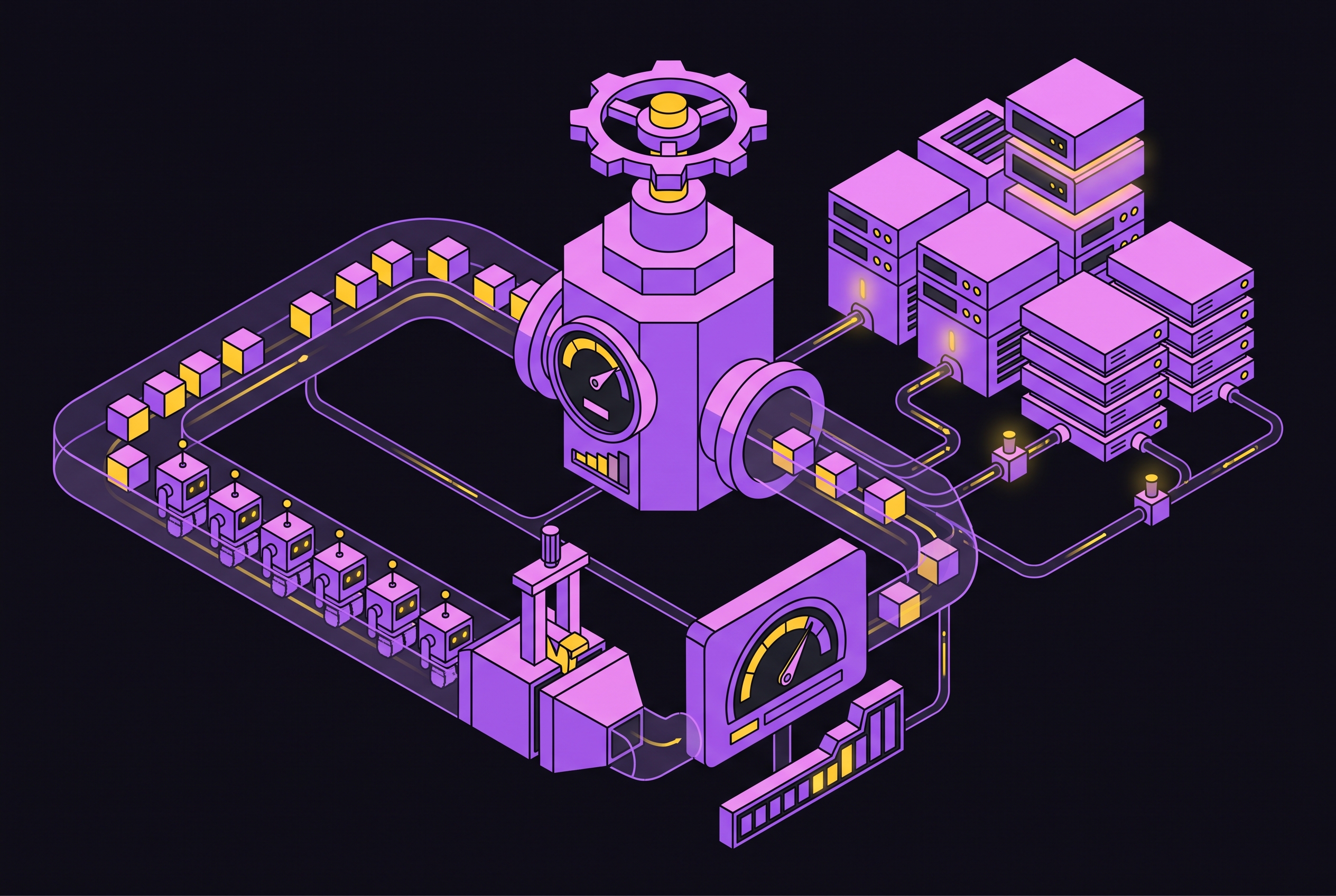
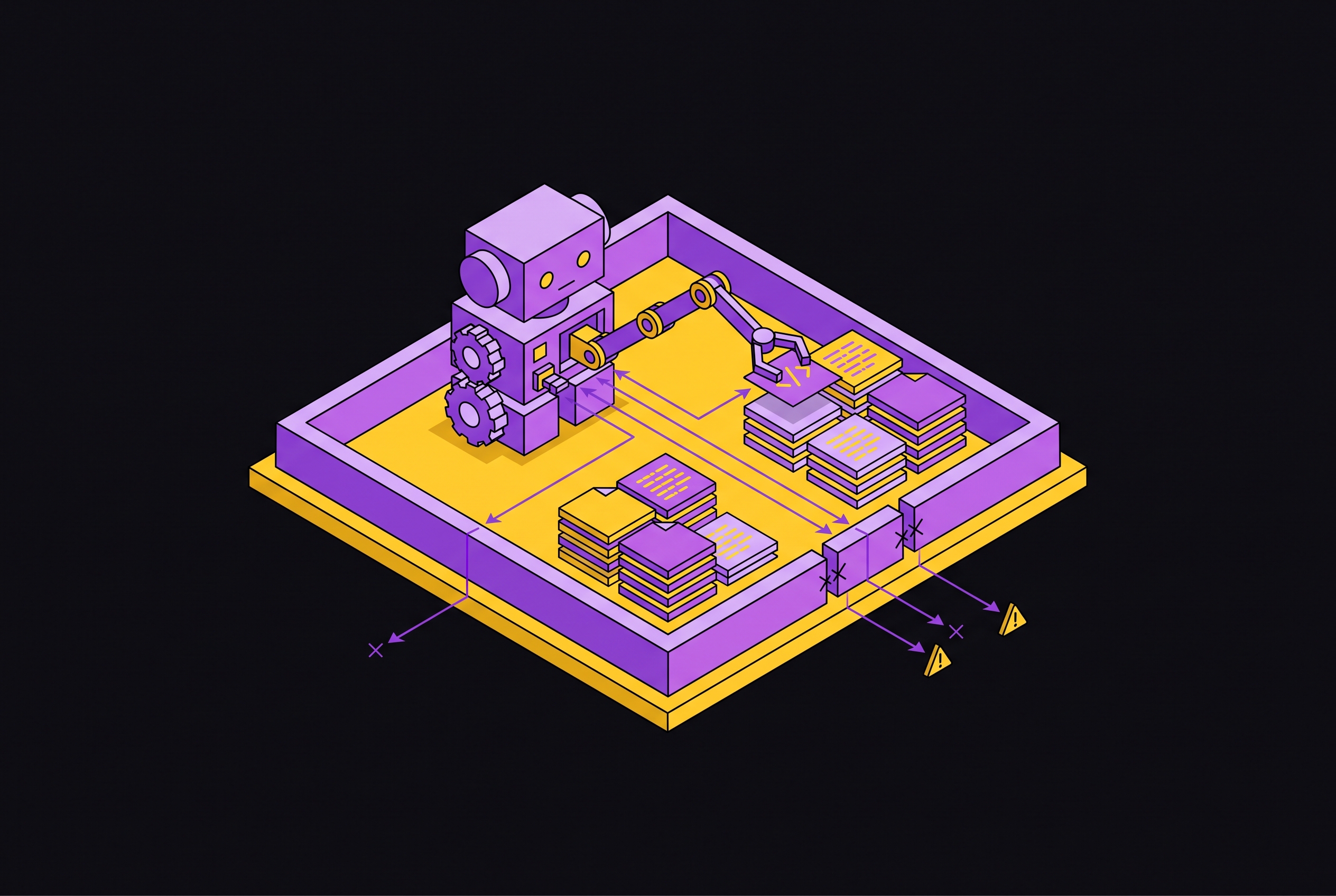
By April 2026, Uber had given roughly 5,000 engineers access to Claude Code, and the company's entire annual AI budget was gone. He placed the blame not on misuse or engineering failure but on the pricing model itself, a consumption-based system that nobody at the company had learned to forecast once thousands of engineers were running it concurrently.
Uber's story produces the paradox that every finance and engineering leader running agents at scale now has to reckon with. Per-token prices have fallen steadily as model providers compete on inference cost, yet total agentic AI spend keeps climbing past projections. The explanation is not pricing. A standard chatbot exchange prices cleanly: one prompt in, one response out, two token counts to track. Agentic systems break that model. An agent plans a task, calls a tool, checks the result, backtracks when the result is wrong, and calls again, and each of those steps carries its own token cost that stacks on top of the last. A cheaper token says nothing about how many tokens a given task will end up consuming once an agent is let loose to reason, retry, and chain its own steps across a production workload.
That gap between unit price and total spend tends to stay invisible until a system reaches real scale. Pilot programs run a handful of agents on a handful of tasks, and the economics look manageable. Production runs the same multi-step agentic loops thousands of times a day across an organization, and that volume multiplies the per-call cost into the total that appears on the invoice. None of this is a story about reckless spending. It is a story about a cost structure that behaves differently from every pricing model that came before it, and about how few organizations have adjusted their forecasting to match.
The four cost layers that drive agentic spend
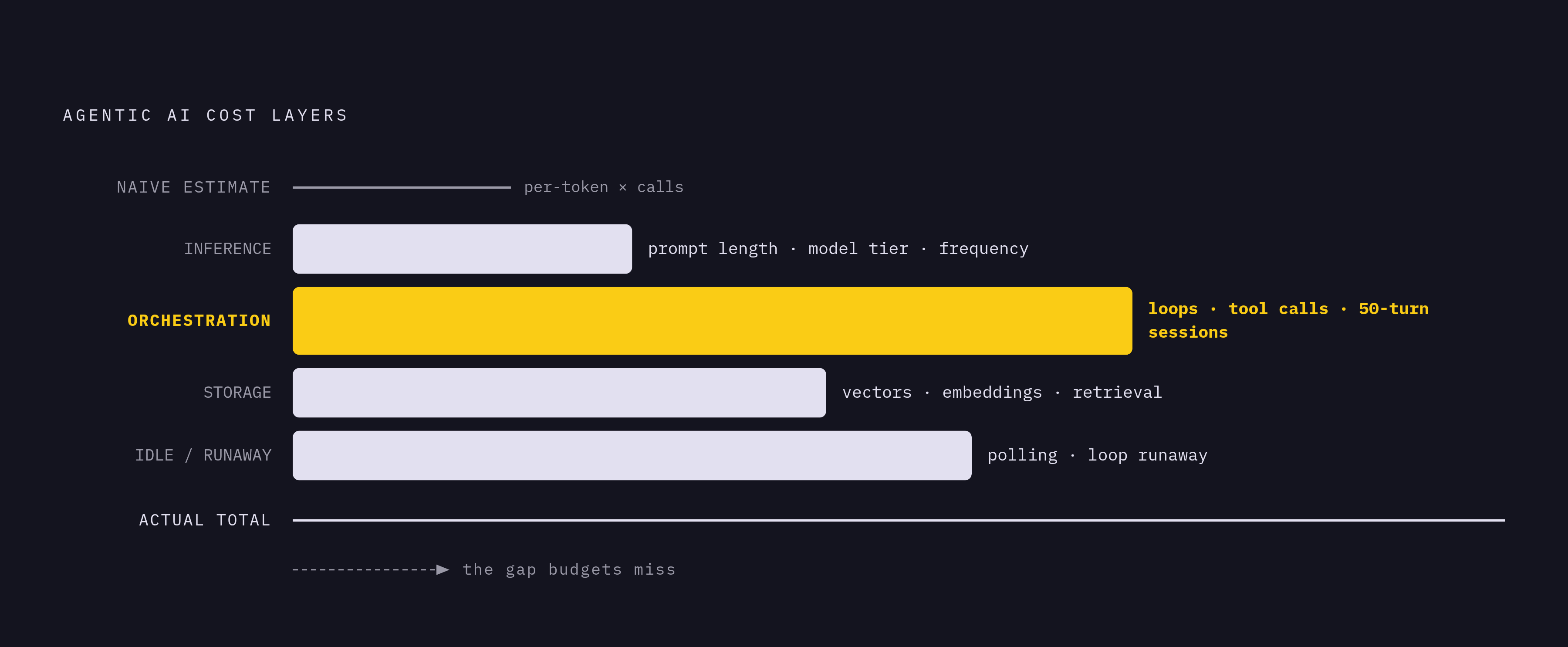
Most cost reviews stop at inference: look at the per-token rate, multiply by expected call volume, and call the budget done. That approach misses three of the four cost layers that actually determine what a production agentic system costs to run.
Inference itself remains the largest single layer, shaped by prompt length, context window size, model tier, and how often the agent calls out to the model. But the second layer, orchestration overhead, often does more damage to a budget than inference pricing ever will. Every reasoning loop, every tool call, every memory retrieval, and every step in a task chain adds its own inference call to the total. A 10,000-token system prompt sent on every call across a 50-turn session alone contributes hundreds of thousands of input tokens before the model has generated a single word of output, and that cost accrues regardless of whether the task needed fifty turns or five.
The third layer sits in storage and retrieval: vector databases, embedding generation, retrieval queries, and the knowledge-base operations that support agent memory. Early budgets consistently underestimate this layer, in part because it doesn't scale with token volume the way the other three do.
Put these four layers together and the shape of the problem becomes clear. Agentic workflows routinely trigger 10 to 20 separate LLM inference calls per user task, not one. Retrieval-augmented architectures can inflate context windows to three to five times their baseline size. These facts are invisible in a simple per-token price calculation, so teams that model only inference end up surprised by their total bill.
Budget caps and cheaper models as flawed primary responses
Faced with a bill like Uber's, most organizations reach for one of two fixes: cap spending or swap in a cheaper model. Both treat a symptom instead of the structural dynamic that produced the bill, and both carry costs of their own.
A budget cap, like the $1,500-per-employee monthly ceiling Uber eventually put in place, is a governance control. It stops the bleeding at a fixed point, but it does nothing to change the rate at which a given task generates tokens. The underlying agent still makes the same number of redundant calls, still re-sends the same bloated context, and still loops the same number of times. The cap just determines when the organization runs out of budget, not whether the system is efficient.
Swapping in a cheaper model across the board is worse, because it tends to produce the opposite of its intended effect. Three failed attempts at a lower per-call price can add up to more than the cost of a single successful call at a higher tier. That means the right comparison is cost per accepted result, not cost per call, and a blanket downgrade routinely loses that comparison even while every individual call looks cheaper on paper.
The downgrade carries a second cost that's harder to see in real time. A quality regression from an underpowered model doesn't register in the token-spend dashboard the week it happens. It appears weeks later in resolution rates, customer satisfaction scores, or whatever business metric the agent was built to move, by which point the connection to the model swap is no longer obvious. Sam Altman, OpenAI's CEO, told CNBC that cost concerns went from an issue customers rarely raised to the second-most common issue he hears from them, in the span of a few months. Caps and downgrades can't fix a misalignment like that. Only a change in how the system itself is architected can.
Model routing as the first structural decision
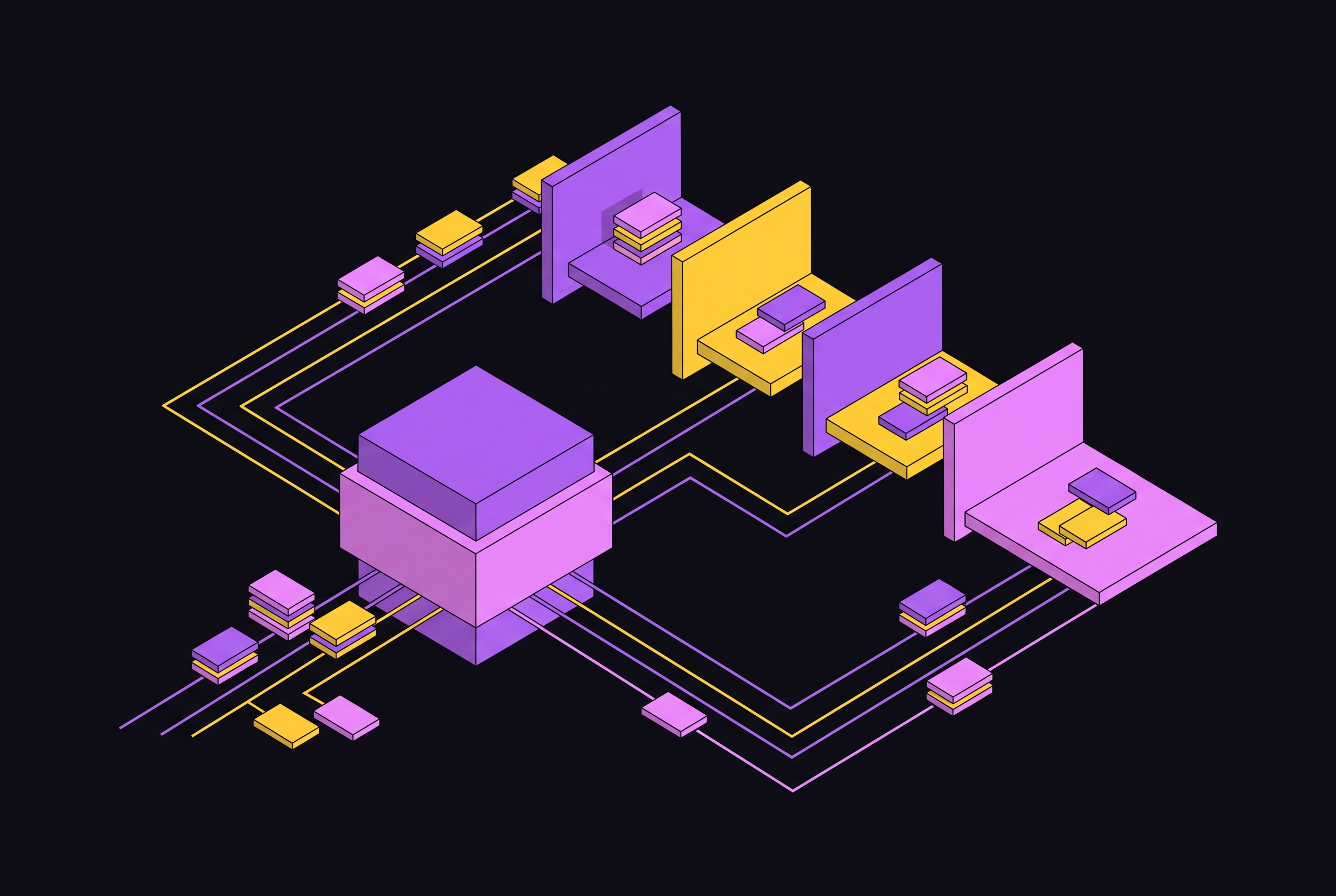
Routing sends each task to a model whose capability matches the task's complexity, instead of defaulting every call to the same tier, and it is the first and highest-leverage architectural decision.
The principle is straightforward to state and easy to get wrong in practice. Simple, well-defined tasks, like classification, formatting, or routine lookups, belong on cost-efficient models. Complex reasoning or high-stakes decisions belong on frontier models capable of handling them correctly the first time. A system that routes its workload across tiers according to actual task complexity, rather than running everything on one model, can bring average per-query cost down substantially compared to a single-model architecture.
The failure mode sits right next to the solution and looks almost identical from a distance: a blanket policy that routes every task to the cheapest available model regardless of what the task actually requires. That's the same mistake described in the previous section, just moved earlier in the design process. Routing has to match capability to task. It can't be used as a way to minimize model size as a goal in itself.
Building routing logic that works takes real engineering investment. None of that happens automatically from a configuration flag. Getting the routing decision right at the architecture stage is what prevents the cost structure from drifting back toward the Uber scenario once the system is running at real volume.
Context management as an ongoing architectural discipline
Routing determines which model handles a call. Context management determines how much that call costs regardless of which model answers it, and it has to be treated as an ongoing discipline rather than a prompt tweak applied once and left alone.
In naive implementations, every piece of an agent's memory gets injected into every inference call, whether or not it's relevant to the task at hand. That approach scales linearly with how much the agent remembers, and as memory accumulates over weeks or months of operation, the cost of every single call climbs along with it. Retrieval-based memory architecture replaces that pattern: instead of injecting the full history into every call, the system retrieves only the context relevant to the specific task in front of it. The size of that reduction is the evidence that this is a structural choice about how the system is built, available only through a marginal efficiency gain in phrasing.
A separate mechanism, prompt caching, addresses a related but distinct part of the same problem and shouldn't be confused with retrieval architecture. Where retrieval-based memory decides what content gets sent to the model, caching addresses what happens when the same content, like a stable system prompt or a repeated document reference, gets sent across multiple calls. Once a provider's cache has stored that content, subsequent calls that reuse it avoid the cost of reprocessing it from scratch. ProjectDiscovery put this into production and cut costs by roughly three-fifths after implementing prompt caching, reaching about seven-tenths over the following days, with a cache hit rate approaching three-quarters. These are two separate levers: retrieval-based memory is an architectural decision about system design, and prompt caching is a provider feature that rewards systems with stable, reusable prompt structure. Regular prompt audits, catching verbose or poorly structured prompts across high-volume agents, deliver immediate cost reductions without requiring any architectural change at all, but that kind of cleanup works best as a supplement to the retrieval and caching decisions, not a substitute for them.
Loop controls and batch routing that enforce cost ceilings per task
Model choice and context design determine what a single call costs. The remaining variable is time: how long a task is allowed to run before it's cut off, and whether it needs to run in real time.
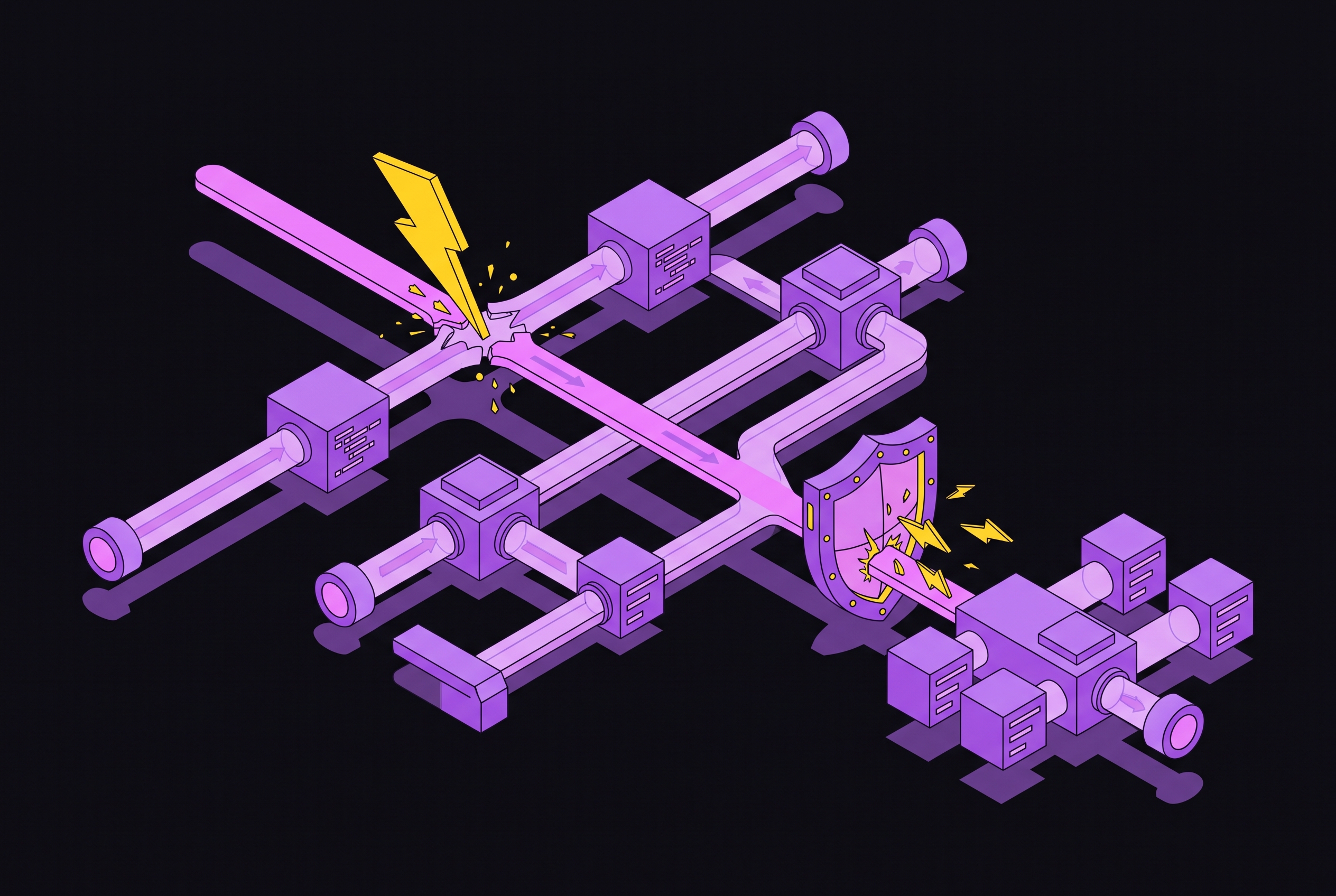
Token budgets and circuit breakers address the first half of that question directly. A circuit breaker is an automatic stop triggered once a task crosses a defined inference threshold, and putting one in place at the task level protects the system's unit economics by preventing any single task from spiraling into runaway cost. The budget has to be set at the task level specifically, not just at the system level. A system-wide cap catches the total spend eventually, but it does nothing to stop one misbehaving task from consuming a disproportionate share of that total before the cap ever triggers.
Idle compute is the other side of the temporal problem, and it's worth a brief, direct mention because it shows that governance failures generate cost just as surely as architectural ones do. Monitoring agents built to run continuously keep consuming compute even during long stretches when nothing meaningful is happening, which is a governance failure as much as a design one: nobody set the agent to activate only when needed. Event-driven activation, where an agent runs in response to a trigger rather than polling continuously, is the architectural default that avoids paying for compute that produces nothing.
Batch routing addresses workloads that don't need an answer immediately. Both OpenAI and Anthropic offer batch API endpoints with a 24-hour completion window at a 50% discount against standard pricing. Routing eligible work to batch endpoints is one of the few savings available in this entire framework that costs nothing in system performance to obtain.
Agentic compilation as an alternative to continuous-inference loops
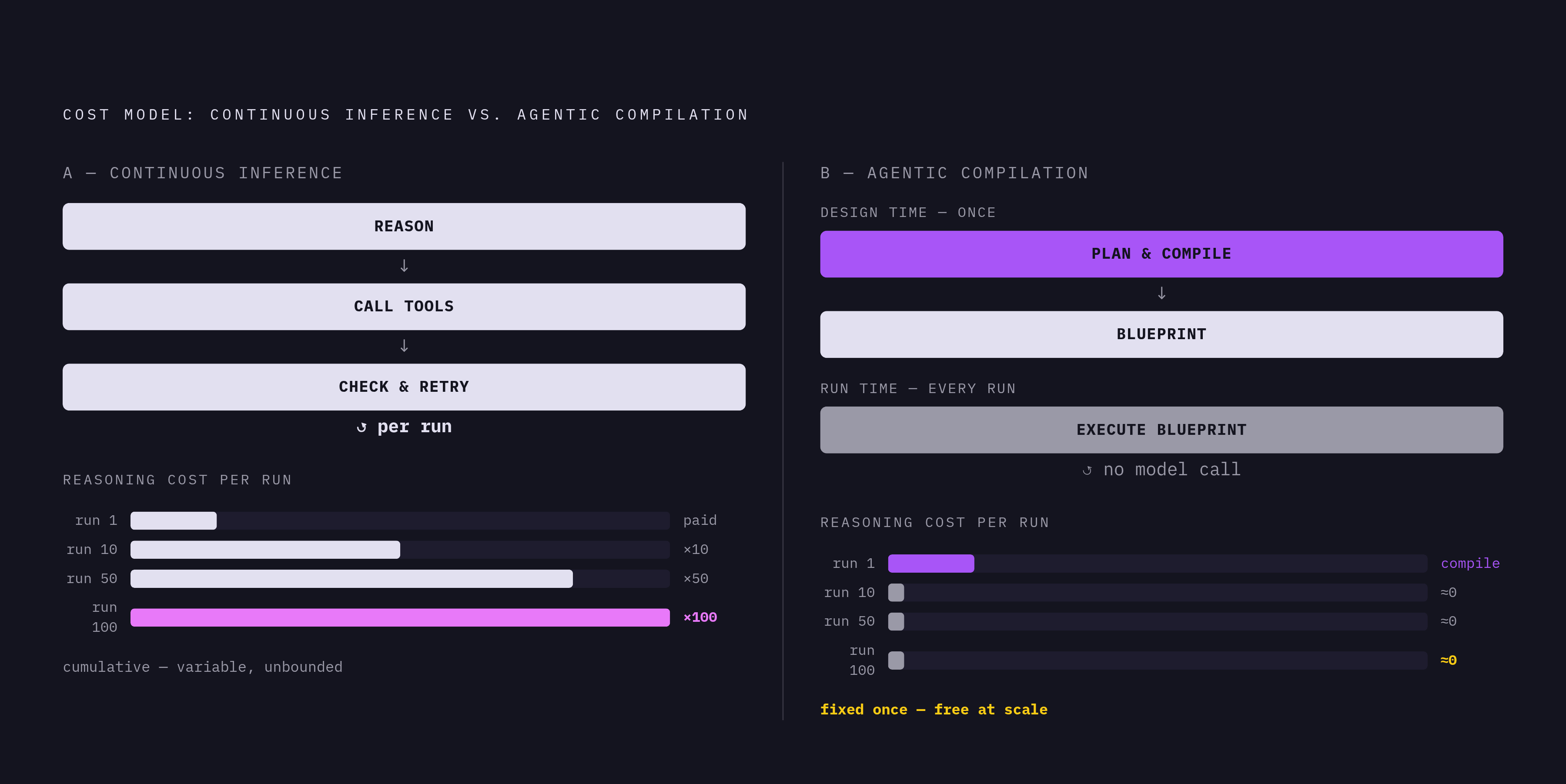
Every lever covered so far reduces the cost of a continuous-inference loop without changing its basic shape: the agent still reasons, calls tools, and checks its own work on every single run. Agentic compilation changes the shape itself. Instead of letting an agent reason through the same workflow from scratch every time it runs, a single planning call generates a deterministic, executable blueprint once, and the workflow executes that blueprint on every subsequent run rather than re-invoking the model to reason through it again.
The cost difference this produces is not incremental. A multi-step workflow run hundreds of times under continuous inference accumulates cost with every single run, because every run re-pays for the reasoning, the tool-call decisions, and the self-checking that a compiled blueprint only has to pay for once. Even aggressive caching applied to the continuous-inference version doesn't close that gap, because caching reduces the cost of repeated content within a reasoning loop, while compilation removes the reasoning loop from the repeated execution. The practical effect is that cost shifts from a variable charged per run to something closer to a fixed cost paid once at design time.
This approach works only for a specific category of workload: high-repetition, predictable tasks where the steps don't change from one run to the next. The architectural judgment call comes before any of this gets built: deciding which workflows are repetitive and predictable enough to compile, and which ones genuinely need an agent reasoning live on every run.
A compiled blueprint executes the steps the model already reasoned through once, instead of asking the model to re-generate and re-bill for that same reasoning trace on every subsequent run.
Measuring cost per outcome rather than cost per token
Every architectural choice covered here, routing, context management, loop controls, compilation, reduces cost in a way that's visible in a token dashboard. None of them is validated by that dashboard alone, because a lower token count can coexist with a worse result, and the dashboard has no way to show that.
Cost per token tells you an agent got cheaper to run. It says nothing about whether each dollar spent still buys the same quality of outcome it used to. Cost per resolved outcome catches the failure mode that cost-per-token metrics miss entirely: a resolution-rate drop that accompanies a cost reduction, where the token-price line on the dashboard goes down at the same time the real cost of getting a task actually done goes up. Teams that optimize purely for token savings can introduce this kind of regression, and it surfaces weeks later in business metrics, like customer satisfaction or task completion rates, before it appears in the API spend numbers that triggered the optimization.
A system that looks cheaper by every inference metric available can still be failing the people who depend on it, and measuring cost against the result the agent was built to deliver is the only way to know the difference.